
Sports Card Collector Resources!
We invite you to check out the below resources that may help you on your sports card collecting journey.
Also included are important card collector terms and their meanings that all collectors should be familiar with.
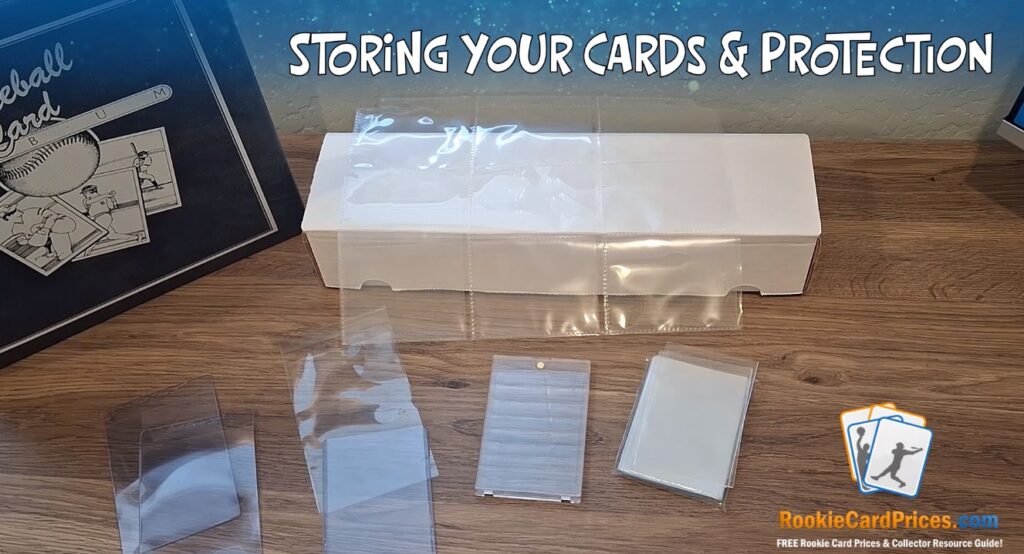
Learn about the many products and methods for storing and protecting your cards

Learn about determining if a card should be sent out for grading and how to estimate a cards grade
We may have affiliation with some of the below businesses and resources.
Card Collecting Products & Resource List
Card Manufacturers
Card Grading Services
- PSA – Professional Sports Authenticators
- SGC – Sports Card Grading
- BGS – Beckett Card Grading Service
- CGC – Certified Guaranty Company
Market Places & Auctions
Card Collector Accessories
Price Guides & Value Services
- Rookie Card Prices – Yes, we listed our own site.
- Beckett
- Collectors
- Sports Card Investor
- Collx
- PriceCharting
- Card Hedger
- Vintage Card Prices (VCP)
- 130Point
- Card Ladder
Card Collector Terms Glossary
Altered
A card that has some sort of alteration of change from its original version. For example trimming an edge, adding something to the design not originally printed from the factory or recoloring.
Authentication
Many high value cards or collectables may be faked in some way either via reprinting or fake signatures. Sending your cards to an expert authenticator will not only prove its legitimacy but can help your card sell for a higher value. Most popular sports card authenticators are: PSA, SGC and BGS.
Base Card
Base cards refer to the main set cards for the particular year. Any parallels, signatures, relics, subsets would not be considered base set cards.
Break
Many collectors enjoy opening sealed boxes and packs of cards. Simply a break is when you perform the opening. Many online influencers will conduct group breaks where they open boxes on their channels and viewers can pay to be a part of the break/opening.
Card Saver
A card saver is a plastic card protector that is also called a simi rigid holder. By placing the card within this type of holder you can protect the surface and corners of your collectable from being damaged. Card savers are the preferred method for sending your cards in to grading. Many collectors like card savers over top loaders as cards can fall out of top loaders easily and move inside the holder itself.
Learn more about Card Savers and other card holders.
Cello
A form of retail card product where the cards are wrapped in a clear cellophane type wrapper. The other most notable sports card packaging of the past is the wax pack.
Chase Card
Just as it sounds, a chase card is one collectors are looking for most in the card product release. It’s the card everyone is “chasing”.
Declared Value
When you send a card in for grading you will be asked to declare a value or estimated value of your collectable. Obviously you wont know exactly how the card will grade, but its important to estimate. If the submitted card grades higher than expected or is valued much higher than your estimate, the grading company may change extra for grading that particular card.
Error Card
An error card is a card with some sort of error either in the player stats, information or wrong photos. Some error cards can fetch a large premium depending on the error. While others may not change value at all. Error cards should not be confused with print defects or printing errors.
Factory Set
A factory set is a sealed or complete set of cards direct from the factory opposed to a set that was compiled by a collector.
Gem Mint Condition
This is the top grade or a card with so few flaws that it receives the highest grade possible. For example PSA grade of 10. Learn more about PSA grading standards.
Grading & Grading Scale
Grading is the process of authenticating and assigning a card a number from 1-10 on a grading scale. The card is then placed into a sealed case. While each grading service company is different and has their own process, most grade from a scale of 1-10 with some half grades and qualifiers available.
Insert
An insert card is one where it is not part of the base set. It could be a subset or chase card that is tougher to find then the main base cards. Inserts became popular in the late 80’s and early 90’s.
Junk Wax
The term “Junk Wax” usually refers to the time period or era from mid 1980’s to mid 1990’s. During this time card manufacturers printed so many cards that they flooded the market. This caused many of the cards to remain low in value even today. In fact, you can find unopened boxes of many late 1980s cards today for low prices. With grading, some of these “junk wax” ear cards can still hold high values in high grade.
Mint Condition
When we say “mint” we usually refer to a card with no major flaws. A card that appears to be direct as printed from the factory with no corner, edge or centering issues. However does allow for some small flaws. An example is a 9 grade from most reputable grading companies.
Parallel
A parallel would include cards that are similar to the base set card but could be a different color, serial numbered or other variation. This has been a much more standard practice in modern era card sets.
Penny Sleeves
A penny sleeve is a thin clear plastic sleeve usually used in combination with top loaders or card savers to add extra protection to the card. It is considered the cheapest card protectors available.
PC (Personal Collection)
Collectors and dealers refer to their own collection as their PC or personal collection. These are the cards they keep and are not selling with standard inventory.
Qualifier
When grading a card that qualifies for a specific grade but has one area that would not normally fit the grade. For example a stain, overly off center or pen mark.
Some qualifiers are stain (ST), off-center (OC), print defect (PD) or marks (MK). The grading company would give the card the numerical graded but include the specific qualifier on the label as well.
Rated Rookie
All the rage in the junk wax era, “Rated Rookie” was a term used primarily by Donruss to showcase some of their rookie cards. These cards would have a blue text “Rated Rookie” on the front of the card. You still may find this being used today on some card sets.
Raw Card
Simply, a raw card is one that is not graded or authenticated in any way. Any card direct form a pack, box or collection that is without third party grading.
Refractor
This term comes from the idea of refracting light. Refractor cards are ones who show an effect to light in some way. This can include rainbow colors and patterns. The word Prizm is also used by Panini to describe the same type of printing effects.
Reprint
Many card companies have taken popular or highly sought after cards from the past and reprinted them with some small change. This could be a logo, text or stock change that is different from the original card. While most reputable companies did not intend for reprints to be deceptive, it can be tough for new collectors to tell the difference in some cases.
Rookie Card
A true rookie card is the first appearance of a player on a trading card by a specific card manufacturer usually their first year of play in the pro sport. Rookie cards usually hold higher value than a players later year cards.
Short Print
Cards that are printed in less quantity then the other cards in the set or release. This would also include many serial numbered cards and abbreviated (SP).
Top Loader
Collectors will use top loaders in combination with penny sleeves to protect cards. These are more ridged and thicker plastic then the penny sleeve alone and the card is loaded from the top.
Vintage
While subjective most collectors feel cards produced from 1980 and earlier to be vintage. It is the era before junk wax.