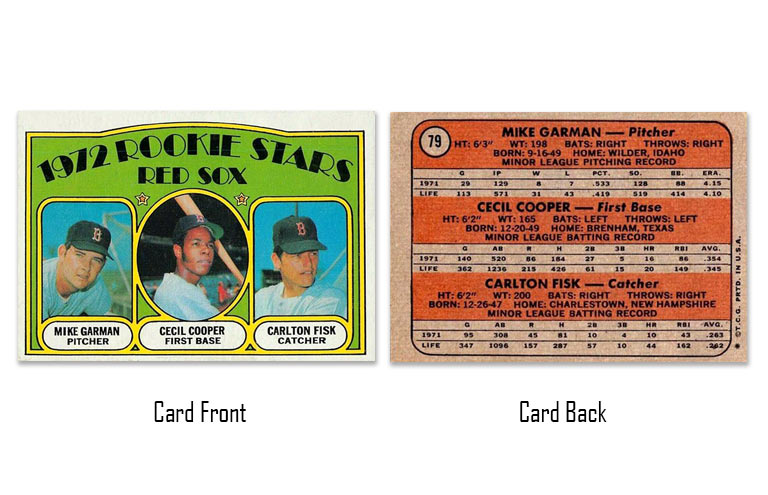
Manufacturer: Topps
Set: 1972 Topps Baseball ➡️
Player Name: Carlton Fisk
Position/Team: Catcher for Red Sox
Card #: 79
Card Size: 2-1/2” x 3-1/2”
Card Values: See Pricing Table Below
Carlton Ernest Fisk, also known as “Pudge,” was an iconic and fiercely competitive catcher whose 24-year Major League Baseball career (1969-1993) spanned two teams, the Boston Red Sox and the Chicago White Sox.
He burst onto the scene in 1972, winning the American League Rookie of the Year award. That season, he batted .293 with 22 home runs and 61 RBIs. Notably, he led the AL with nine triples, a rare feat for a catcher, showcasing his surprising speed.
Fisk’s most iconic moment came in Game 6 of the 1975 World Series against the Cincinnati Reds. In the bottom of the 12th inning, with the score tied 6-6, he hit a towering fly ball down the left-field line. As the ball sailed towards the Green Monster, Fisk famously stood at home plate, waving his arms frantically, willing the ball to stay fair. It hit the foul pole for a walk-off home run, forcing a Game 7 in one of the most thrilling games in baseball history.
After a contract dispute and a contentious free agency period, Fisk signed with the Chicago White Sox in 1981, a move that shocked the baseball world. In 1990, he broke the record for most home runs by a catcher (previously held by Johnny Bench). He finished his career with 376 home runs, 351 of which came as a catcher, which remained the all-time record for catchers until surpassed by Ivan Rodriguez. He made four All-Star teams with the White Sox (1981, 1985, 1988, 1991). Fisk won a Gold Glove Award (1972) and three Silver Slugger Awards (1981, 1985, 1988).
Carlton Fisk was elected to the National Baseball Hall of Fame in 2000 on his second ballot, receiving 79.6% of the votes. His plaque depicts him with a half-Red Sox, half-White Sox logo, reflecting his significant contributions to both franchises. Both the Boston Red Sox (No. 27 in 2000) and the Chicago White Sox (No. 72 in 1997) retired his uniform numbers, a rare honor that underscores his impact on two different teams.
Carlton Fisk’s iconic rookie card is this 1972 Topps #79. This card is part of the distinctively designed 1972 Topps set, known for its bold, “psychedelic tombstone” borders. It’s a multi-player “Rookie Stars” card, featuring Fisk alongside another future notable player, Cecil Cooper.

Shop current listings for this card on ebay!
Clicking a link to eBay may result in a referral commission being paid if a purchase is made.
Pricing Data For This Rookie Card
➡️ See All 1972 Topps Rookie Card Prices
Pricing chart includes raw card price & some graded card value estimates.
These values are collated from a variety of resources including recently sold listings, sales averages and a variety of other sports card pricing data sources. Please see full disclaimer on “Terms Page” for more information.
(Rookiecardprices.com only shows values for regular base set cards. No prices are shown for errors, parallels, subsets, misprints or other cards unless noted.)
DISCLAIMER: This data is not intended as financial advice and should not be used as such. Please do your own research before making any investment or selling/buying decisions.
Did You Know? Fisk is permanently etched into sports lore for hitting one of the most iconic home runs in baseball history: his 12th-inning, walk-off blast down the left-field line in Game 6 of the 1975 World Series.
What few realize is how that specific moment revolutionized how sports are broadcast on television. Prior to 1975, television directors universally instructed camera operators to follow the flight of the ball. However, the NBC camera operator stationed inside the iconic left-field wall at Fenway Park, Lou Gerard, was distracted by a massive rat scurrying near his feet.
Rather than panning his camera up into the night sky to find the ball, Gerard kept his lens tightly locked onto Fisk. Because of that happy accident, millions of viewers at home got to watch Fisk’s live, unscripted choreography as he frantically hopped sideways and waved his arms to the right, physically willing the ball to stay fair. The shot proved to network executives that capturing raw human emotion was infinitely more compelling than tracking an object in the sky, completely altering modern sports production.

More Rookies From 1972 Topps Baseball