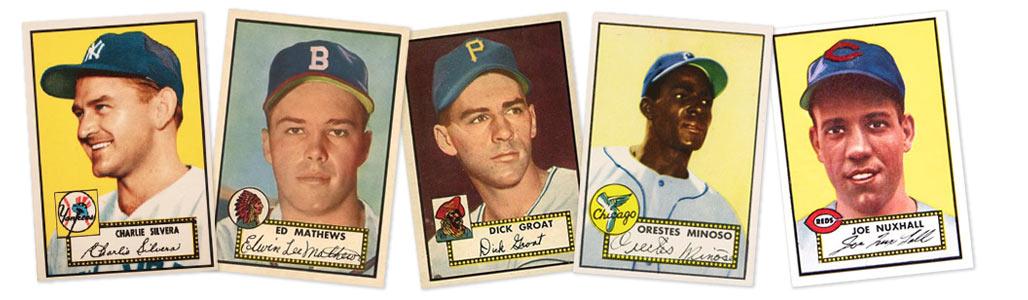
Manufacturer: Topps
Set Size: 407 Cards
Card Size: 2-5/8” x 3-3/4”
Set Notes: The 1952 Topps baseball card set is easily one of the most iconic sets of all time. This issue is considered by many collectors and historians to be the most important post-war baseball card set. It’s HOF star lineup and rookies make it a vintage collectors dream. Many collectors call the Mickey Mantle card #311 from this set his rookie, however this is technically untrue as the 1951 Bowman set in the prior year holds what most consider his true rookie card. The 1952 Topps cards display a color photo of the player, signature type name and team logo in color on the front. For the first time the backs included the players last year stats in addition to number and bio. Cards #1-80 can be found with both red and black ink varieties. Cards #311-407 are also considered very scarce and difficult to find.
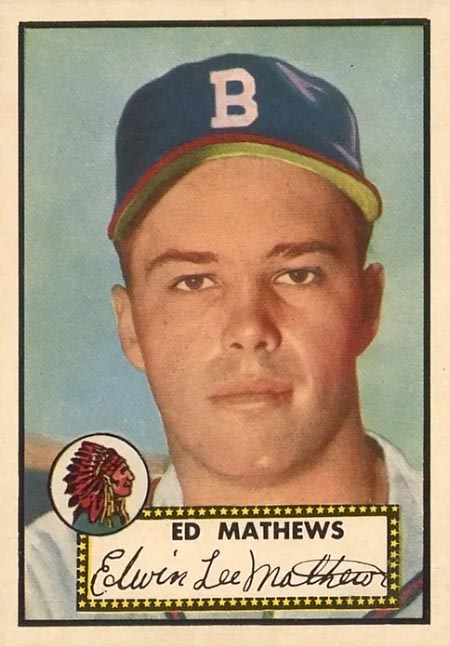
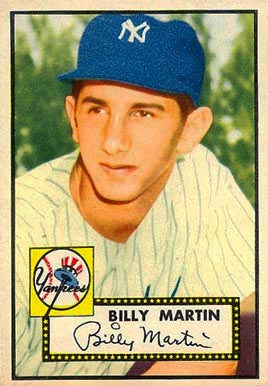
Key Rookies From 1952 Topps: | 175 – Billy Martin | 195 – Minnie Minoso | 392 – Hoyt Wilhelm | 407 – Ed Mathews
Pricing chart includes raw card price & some graded card value estimates.
These values are collated from a variety of resources including recently sold listings, sales averages and a variety of other sports card pricing data sources. Please see full disclaimer on “Terms Page” for more information.
(Rookiecardprices.com only shows values for regular base set cards. No prices are shown for errors, parallels, subsets, misprints or other cards unless noted.)
DISCLAIMER: This data is not intended as financial advice and should not be used as such. Please do your own research before making any investment or selling/buying decisions.
(–) : No Pricing Data Available | ($) USD Price Value | (¢) USD Price Under $1
1952 Topps Rookie Card Prices
| Description | Card # | Raw | 1 | 2 | 3 | 4 | 5 | 6 | 7 | 8 | 9 |
|---|---|---|---|---|---|---|---|---|---|---|---|
| James E. Runnels | 2 | $10 | $15 | $20 | $45 | $155 | $250 | $550 | $3,350 | $3,700 | - |
| Billy Loes | 20 | $25 | $35 | - | $100 | $220 | $400 | $420 | $1,115 | $6,300 | - |
| Charlie Silvera | 168 | $12 | - | $15 | $20 | $40 | $45 | $90 | $240 | $840 | - |
| Billy Martin | 175 | $130 | $135 | - | $200 | $240 | $425 | $560 | $1,285 | $6,000 | - |
| Minnie Minoso | 195 | $100 | - | $130 | $215 | $280 | $475 | $1,100 | $2,380 | $4,500 | - |
| Ralph Houk | 200 | $20 | $30 | $35 | $45 | $50 | $75 | $120 | $260 | $900 | $6,300 |
| Joe Collins | 202 | $12 | $15 | $15 | $25 | $45 | $65 | $80 | $235 | $990 | $4,920 |
| Bob Friend | 233 | $15 | $20 | $20 | $25 | $40 | $50 | $150 | $225 | $705 | $3,350 |
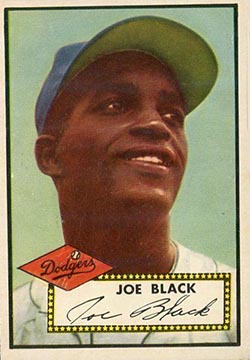
| Joe Black | 321 | $160 | $180 | $265 | $385 | - | $550 | $660 | $2,045 | $4,900 | $8,565 |
| George Shuba | 326 | $150 | - | - | $270 | - | - | $718 | $1,115 | $5,200 | - |
| Wilmer Mizell | 334 | $140 | $150 | - | $160 | $285 | $310 | $660 | $760 | $2,875 | - |
| Clem Labine | 342 | $150 | $150 | $150 | $165 | $325 | $585 | $600 | $820 | $1,525 | $16,200 |
| George Crowe | 360 | $150 | - | $150 | $350 | - | - | $360 | $1,065 | $5,500 | - |
| Dick Groat | 369 | $250 | - | $330 | $400 | $500 | $720 | $1,200 | - | $4,650 | - |
| Gil McDougald | 372 | $230 | $250 | - | $250 | $500 | $805 | $815 | $2,300 | $2,700 | - |
| Jim Turner | 373 | $150 | - | - | $200 | $275 | $500 | $600 | $900 | $4,650 | - |
| Sam Jones | 382 | $130 | $130 | $160 | $245 | $430 | $500 | $560 | $1,175 | $2,175 | - |
| Hoyt Wilhelm | 392 | $1,350 | - | - | $1,500 | $2,400 | $2,300 | $4,000 | - | $6,600 | - |
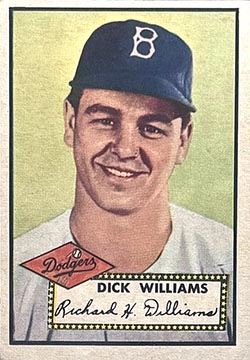
| Dick Williams | 396 | $275 | $150 | $400 | $410 | $450 | $540 | - | $1,715 | $4,000 | - |
| Joe Nuxhall | 406 | $600 | - | - | $650 | $1,600 | $1,800 | $2,000 | $4,565 | $7,400 | - |
| Eddie Mathews | 407 | $3,500 | $3,600 | $4,700 | $5,000 | $5,500 | $11,000 | $14,400 | $32,400 | $160,000 | - |
| Data Updated: March 2026 | |||||||||||

Overview of 1952 Topps Baseball Cards
The 1952 Topps baseball card set is widely considered one of the most iconic and important post-war card issues in the hobby. It marked Topps’s entry as a major player in the baseball card market, directly competing with the established Bowman brand.
Larger Card Size: A significant departure from Bowman’s smaller cards, Topps “jumbo-sized” their cards to 2−5/8″×3−3/4″. This larger format allowed for more detailed and vivid imagery.
Colorized Portraits: The cards feature fully colorized portraits of players, often with striking colors, team logos, and facsimile signatures on the front.
Comprehensive Backs: The card backs include player statistics from the 1951 season, lifetime stats, and a brief biography, setting a new industry standard.
“Red Back” and “Black Back” Variations: Cards numbered 1-80 in the first series can be found with either black or red ink on the reverse. Red backs are generally considered rarer.
Total Cards: The set comprises 407 cards, a substantial checklist for the time.
Six Series Release: Topps released the set in six distinct series throughout the year, aiming to maintain collector interest. This staggered release had a significant impact on rarity.
“High Number” Series (311-407): The final series, often called the “high number” series, is considerably rarer and more valuable. This is due to the fact that by the fall, when this series was released, kids’ interest shifted to football, leading to lower sales. Famously, many unsold cases of these high-numbered cards were dumped into the Hudson River by Topps.
Key Cards and Hall of Famers: The 1952 Topps set is loaded with Hall of Famers and iconic cards, making it highly desirable to collectors.
Mickey Mantle (#311): This is arguably the most famous and valuable post-war baseball card. While not technically his rookie card (his true rookie is the 1951 Bowman), its mystique and the story of the “Hudson River dump” contribute immensely to its value. High-grade examples can fetch millions of dollars.
Rookies: Ed Mathews (#407), Billy Martin (#175), Gil McDougald (#372), and Hoyt Wilhelm (#392).
Errors and Variations: Joe Page (#48) and Johnny Sain (#49) Errors: These cards are known to have each other’s biographies printed on the reverse. These errors are typically found on the black back versions, indicating they were corrected early in the printing process.
Gray Backs (Series 3): Some cards in Series 3 (131-190) can be found with rarer gray cardboard backs. The 1952 Topps set’s blend of aesthetic appeal, significant rookie cards, Hall of Famers, and compelling backstory (especially the Hudson River dump of the high numbers) has cemented its place as a cornerstone of baseball card collecting.
Popular Rookies From 1952 Topps Baseball